The price of a patty: How much more expensive is a South African Burger in 2026?
South Africans love a good burger but the price of putting one on your plate has changed dramatically. With beef inflation running at double digits for most of the past year, this International Burger Day (May 28th) it is worth asking: what does that burger cost you today, compared to last year?
Eighty20, a consumer strategy and analytics business answers that question. Drawing on its own research, Statistics South Africa, BrandMapp and MAPS, we unpack what is really happening to beef consumption in an era of sustained food inflation.
Price shock
Beef inflation surged sharply in mid-2025, peaking between May and July when prices jumped nearly 30% YoY, the most severe blow to meat affordability South Africa has seen in recent memory. Since then, meat has dominated the inflation story. Every month for the past year, at least half of the top ten highest inflation items have been meat products, with chicken rarely far behind.
The cause: a nationwide disease outbreak
South Africa has experienced its worst outbreak of foot-and-mouth disease in decades. Cattle and dairy herds across all nine provinces have been affected, and the supply squeeze runs deeper than livestock lost to illness. Healthy animals are being quarantined too, compounding the shortage and resulting in higher prices.
And people are feeling it in their kitchens. The table below shows how much the cost of inputs for a homemade burger have grown in the past year. Only tomato sauce had lower than inflation price growth, with most inputs more than double inflation.
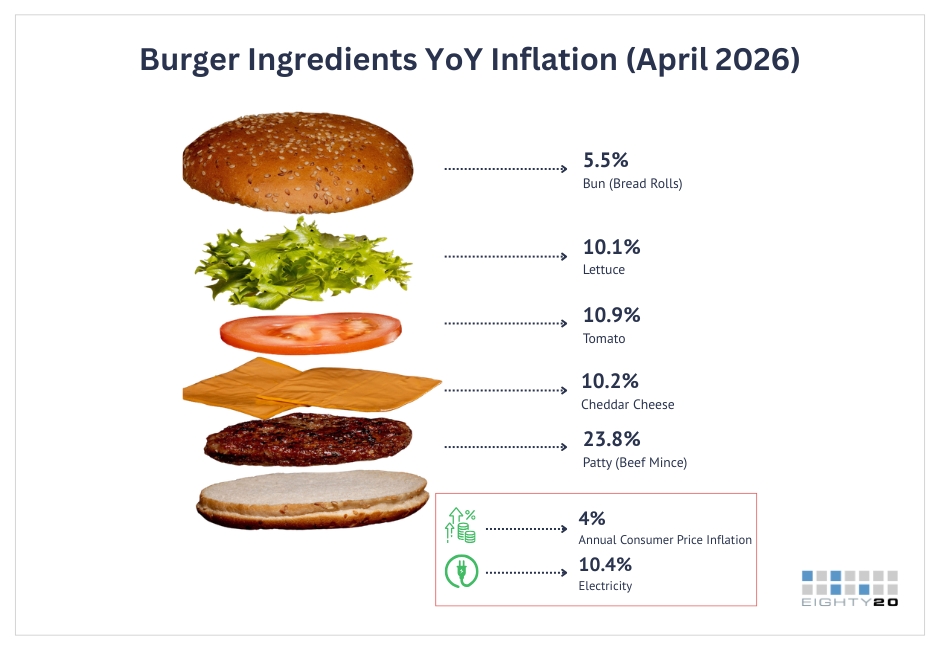
If you are taking the family out for burgers, the jump in prices becomes even more noticeable. Using a Big Mac as a reference point, simply because it is a well-tracked and familiar item, the price has moved from about R55 (~$3) in May 2025 to R70.90 ($4.30) by May 17, 2026, on the McDonald’s app. That is a nearly 30% increase over a year in rand terms, 43% in dollars.
Eating out in South Africa
As burgers become more expensive, the question shifts from price to behaviour: how are South Africans changing their eating-out habits in response?
The MAPS data, a nationally representative survey of 20,000 people conducted by the MRF, asks respondents which fast food outlets they have visited over the past month, past three months, and past year, alongside many other behavioural questions. The chart below highlights several notable consumer trends.
“The first insight relates to frequency. Across the fast-food category, visitation has declined, as reflected in the increase in the share of respondents indicating they have not eaten at a fast-food outlet in the past four weeks. Importantly, this is despite the number of consumers who ate out in the year remaining stable, they are just doing so less often,” adds Andrew Fulton, Director at Eighty20.
|
The second insight points to a shift towards more affordable protein options, particularly chicken. Brands traditionally associated with burgers, such as McDonald’s, Wimpy, and Steers have declined, while chicken-focused brands like Hungry Lion, Pedros and Nando’s alongside two pizza chains have gained ground. This trend aligns with recent media coverage, describing how Hungry Lion and Pedros have been aggressively expanding their store networks and are seeing strong growth in foot traffic, while brands like Wimpy and The Fish and Chip Company have experienced more muted growth.
Recent results from two large food groups, Spur and Famous Brands also speak to these trends. Spur’s FY26 results show sales up 8%, and that average spend per head grew above menu-price inflation, while annual customer counts increased slightly. The results show price-led growth, not volume-led growth. Famous Brands’ most recent results spoke of patrons still consuming, but ordering smaller, simpler, cheaper items within the same brand. One way in which Famous Brands is addressing change is to invest more in smaller format restaurants and drive-thrus to meet consumer demand for value and convenience.
Another dataset, BrandMapp, which speaks to a wealthier segment of South Africans who live in households earning R10,000 or more finds a related trend, although perhaps more health driven. That data finds that 1.7-million people plan to eat less meat (a similar number to those who say they will give up alcohol), 400,000 saying they will become vegetarian and a quarter of a million saying they plan to go vegan.
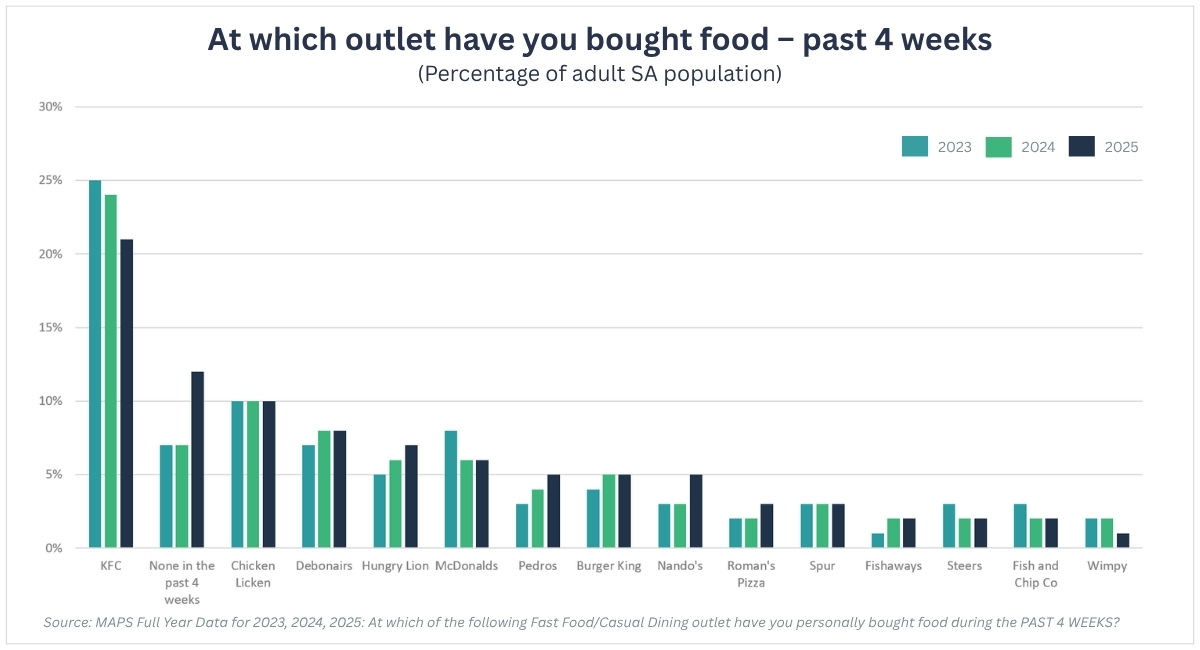
The top 10 fast food outlets include two pizza restaurants, Debonairs and Roman’s Pizza alongside three primarily beef-focused and burger establishments: McDonald’s, Spur, Burger King and Steers. Remarkably, one in four South Africans dined at KFC last month, surpassing the combined customer count of five outlets in the top 10.