Surging fuel price puts South Africa’s inflation and rate cuts at risk
Listen to the Kaya Biz interview here: Inflation Through the Eyes of the Consumer
The Middle East conflict is rapidly reshaping the global inflation outlook. Energy markets responded within days of the conflict starting, sending oil prices sharply higher, and South Africa felt the consequences four weeks later in one of the largest fuel price increases the country has ever seen. Yet the most recent CPI data, for March, captures none of this. It predates both the fuel shock and the new electricity tariff, leaving it as something of a calm before the storm, a release that was largely a story about meat prices.
Against this backdrop, Eighty20, South Africa’s leading consumer strategy, research and analytics firm examined how the inflation picture has shifted over the past year, as the country emerged from a prolonged period of elevated price pressure into what may prove to have been a very brief window of relief.
|
Headline inflation was down in February and held stable in March, primarily because the fuel increase and the electricity tariff increase were not in the dataset. Headline inflation cooled to 3.0% in February, down from 3.5% in January, and only went up slightly to 3.1% in the March data, with food inflation down in each of the past two months.
Measuring inflation requires a consistent and representative snapshot of what South Africans spend their money on. To achieve this, StatsSA regularly collects prices for thousands of items across the country. Each item is weighted according to its share of household spending, and together they form a basket of nearly 400 goods and services – known as the COICOP list – that serves as the foundation for South Africa’s CPI.
CPI tracks the weighted average price of this basket over time, making it the country’s primary measure of inflation and a key indicator of how the cost of living is changing for the population. Importantly, it captures different geographic areas, and the basket’s granular structure of items grouped into categories and subcategories allows analysts to study inflation trends at diverse levels of detail, from broad spending categories down to individual goods.
2025 vs. 2026 Inflation
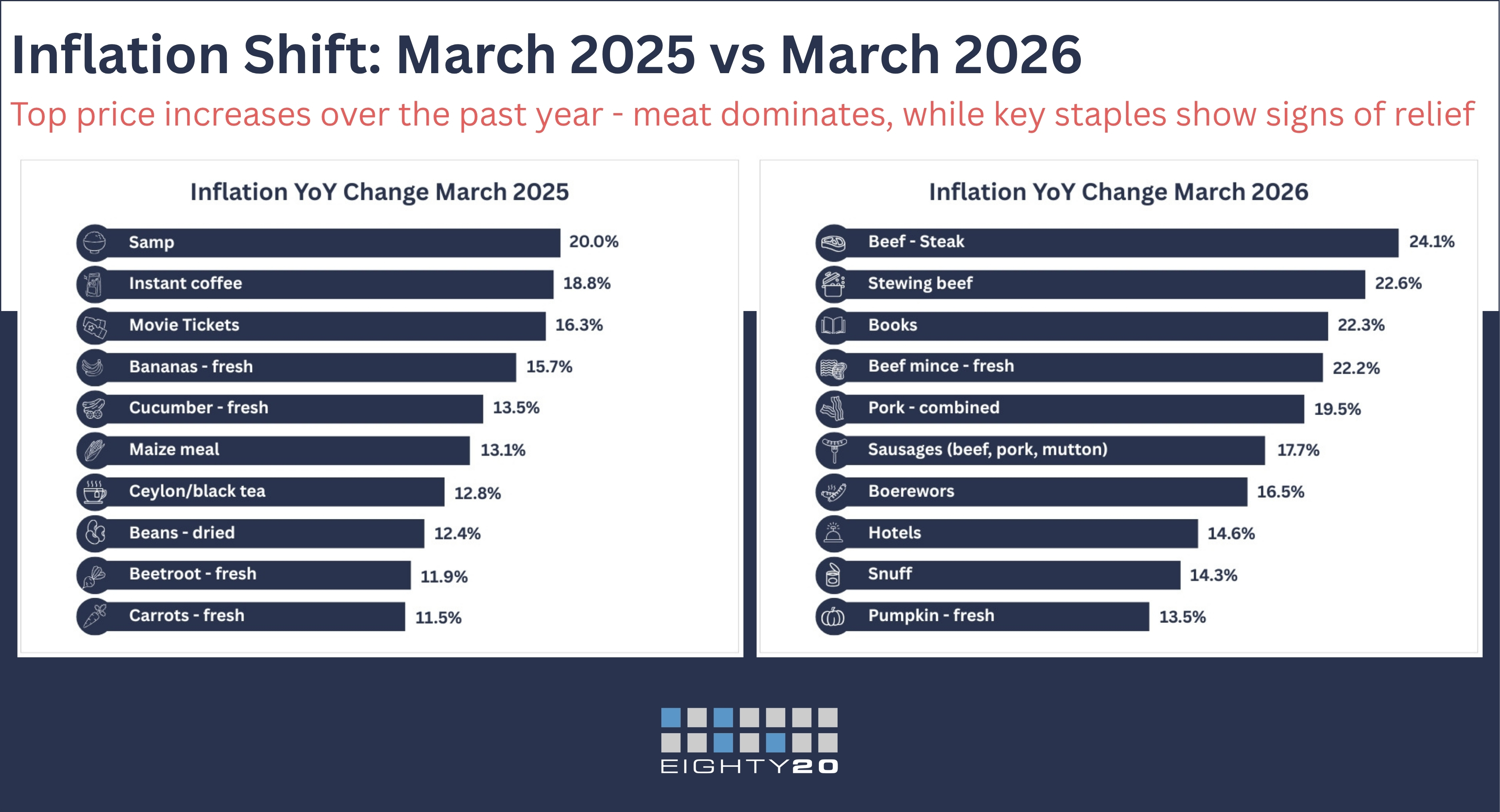
The two tables below compare the items that have displayed the strongest price growth over the past year, comparing March 2025, when US tariffs had emerged as a new economic reality, against the most recent figures from March 2026. Interestingly, the consensus is US tariffs have not had a huge impact on South African inflation but have added inflationary pressures through indirect channels such as the weakening of the rand post announcement raising import inflation.
This month’s inflation story is largely about meat, six of the top ten highest-inflation categories are meat products, with chicken in the top 20. There is, however, a welcome relief for lower-income households: staples like samp, dried beans, and electricity, which featured prominently in last year’s top ten, have since dropped down, providing relief to those households who have an outsized percentage of their income going to food.
Comparing the two data tables highlights how different forces are shaping prices across the food basket. South Africa is currently experiencing its worst outbreak of foot‑and‑mouth disease in decades, affecting cattle and dairy herds across all nine provinces. The disease has sharply reduced meat supply, not only through illness, but also because healthy livestock are being quarantined. This has pushed meat inflation into double‑digit territory.
By contrast, South Africa recorded a bumper maize harvest in the 2024/25 season and benefited from favourable fruit‑growing conditions. Strong domestic supply has therefore eased price pressures on staples such as maize and fruit, explaining why these items feature far less prominently in inflation data than they did last year.
Looking back five years
We also examined how prices have shifted over the past five years since 2021 – a period that encompassed emergence from a global pandemic, a war in Europe, and a sustained cycle of monetary tightening. The biggest mover was instant coffee, up a massive 88.4%, followed by electricity at 74.7%, reflecting Eskom’s successive tariff increases over the period. Also in the top ten were paraffin, toothpaste, laundry soap, cat food, and of course, chocolate.
Not all prices move in one direction, however. A handful of items have experienced sustained deflation, a pattern typically associated with weak demand, excess supply, or rapid technological improvement. Leading that list is cell phones, followed by televisions, laptops, watches, and microwaves. This is a global trend: the actual cost of consumer electronics has fallen consistently for decades as manufacturing efficiencies and competitive markets keep prices in check, even as most other goods become more expensive.
|
Eighty20 will be tracking inflation over the coming months as the impact of the conflict in the Middle East puts pressure on oil prices.
Looking ahead
Fuel prices present the most immediate and direct hit. South Africa imports more than 20 billion litres of crude oil and refined petroleum products each year, all priced in US dollars, meaning geopolitical shocks transmit almost immediately into the domestic economy. South Africans experienced one of the largest fuel price hike on record on 1 April, with diesel set to go around R32 per litre in May.
South Africa will need more US dollars to pay for higher-priced oil, which increases demand for dollars and puts pressure on the rand, further exacerbating the cost of all imports.
Food inflation will rise next. Fertiliser prices are likely to rise as agricultural input costs climb alongside oil as the Gulf region is a major fertiliser producer. Broader supply chain costs will also filter through with longer voyage distances and schedule disruptions reducing global shipping capacity.
The South African Reserve Bank had been widely expected to begin cutting borrowing costs in 2026, but most analysts are now pricing in the possibility of a 25-basis-point rate hike rather than the cut that was previously expected.
|
Investec’s chief economist Annabel Bishop estimated that oil prices around $110 per barrel combined with a weaker rand could push consumer inflation above 4% year-on-year in Q2 2026 which would erase much of the progress made in 2025 when inflation fell to near the Reserve Bank’s 3% target.
“Hopefully, South Africa’s 2026 Budget, which struck a careful balance of scrapping previously planned tax hikes, protecting the social wage, and maintaining fiscal discipline will provide a degree of stability that could help cushion the economy in the short term against these external shocks,” concludes Eighty20.