Festive alcohol trends shaping retail behaviour in South Africa
As we head into the 2025 festive season, alcohol plays a bigger role in gatherings and celebrations across the nation. A 2025 article quoted South Africa’s Social Development Deputy Minister saying that expenditure on alcohol, which according to Trade Intelligence averages about R414m rand per day, nearly triples for the week between Christmas to New Year. This week-long spending spike represents a critical commercial window where understanding consumer behaviour, preferences and purchasing patterns can separate market leaders from laggards.
According to WHO, the world average consumption of alcohol is about 5.5 litres per person per year with South Africa above the global mean at 7.8 litres, but below some European countries like Romania (17.1 litres) or Czechia (13.7 litres). When the denominator is set to drinkers only, South Africa is the 5th highest in the world, with an average of about 30 litres per drinker annually.
Eighty20 Consulting, a consumer insights and data science business, assists brands in finding customer-led growth strategies. Using MAPS, a survey of 20,000 South Africans by the MRF, and several other datasets, we analyse the unique preferences of South African alcohol consumption. We unpack insights by mining secondary data, a valuable source of market understanding allowing companies to gain intelligence quickly, efficiently, and cost-effectively.
|
The MAPS data shows that just under half (47%) of South African adults consumed some form of alcohol in the past month, with beer as the top choice, particularly among men – 68% of weekly beer consumers are male.
In terms of festive celebrations, “Eighty20 used the GWI data, courtesy of YOUKNOW Technologies, which finds that for internet enabled South Africans, wine is the top festive season choice, followed by cider and then spirits.
Alcohol use is more prevalent in urban areas than rural areas, with roughly 10pp more people drinking in metros than rural areas. Another dataset, Roots, which measures a wealthier, urban sample unlike the nationally representative sample MAPS uses, supports this finding, and counts even more drinkers. Nearly 80% of men and roughly 70% of women in metropolitan areas say they drink alcohol.
There are other interesting skews in terms of demographics. Single people and those who live together are more likely to drink than their married counterparts. Younger generations, Generation X and particularly Generation Y are more likely to drink than Baby Boomers (at least 50% more likely).
Age also influences alcohol choice: the average sorghum or fortified wine drinker is around 41 years old, while alcoholic energy drinks attract a younger demographic, with the average consumer roughly 6 years younger.
Understanding category audiences
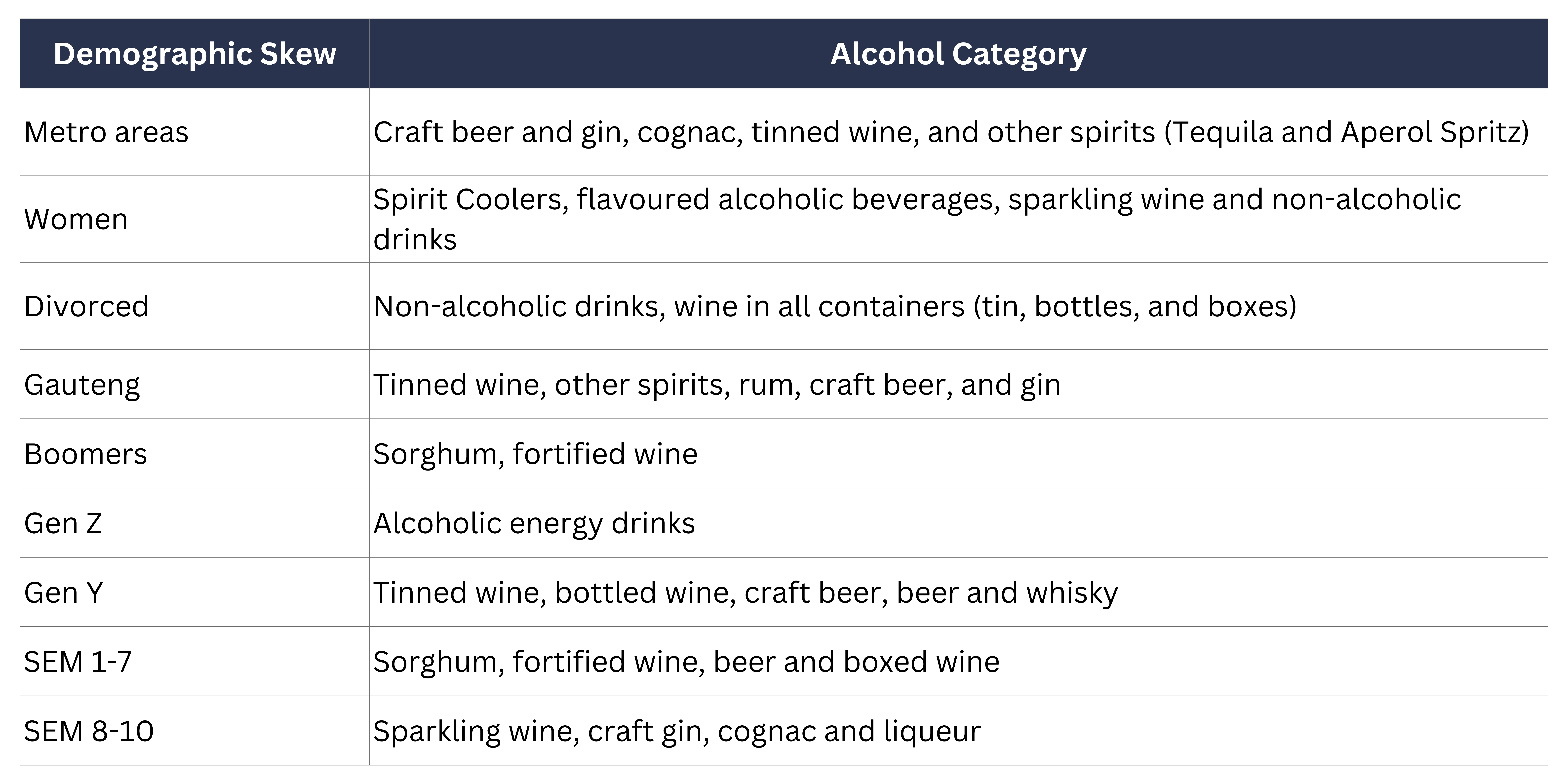
Categories of alcohol cater to different demographics as can be seen in the table below, which highlights alcohol categories and the demographics that over-index for each.
The non-alcoholic market
“Whether it is enjoying the refreshing taste of beer without the effects of alcohol or alternating a non-alcoholic option when you are out drinking, there are close to a million people consuming non-alcoholic beer, cider or gin category in any given week, rising from about 666,000 a year ago” adds Eighty20.
Interestingly, fewer than 5% of these 1m consumers abstain from alcohol altogether, and 57% are female. This might highlight why non-alcoholic cider is much more popular than the beer equivalent. In terms of demographics, the category skews to urban and metro consumers, young singles, couples, Gen Z and Gauteng females.
F1 fans would have noticed the extensive Heineken 0.0 advertising campaigns featuring previous World Champion Max Verstappen as a celebrity endorser. While Heineken 0.0 is the most popular global brand, home grown Castle Free, which benefited from the alcohol ban during covid and was producing 2 million bottles a month in 2021 is rapidly gaining market share locally.
“Understanding how alcohol consumption patterns evolve across different demographics enables retailers and brands to identify growth opportunities in challenging markets. By tracking shifts in drinking preferences across age groups, income levels, and regions, businesses can spot emerging trends. Data-driven insights allow brands to align product portfolios, pricing strategies, and marketing with actual consumer demand rather than assumptions,” concludes Eighty20.