South Africa’s economic outlook softened over the quarter, with GDP contracting more than expected (-0.2% QoQ) in Q2. Inflation reversed course, rising to 4.5% YoY on the back of surging petrol and diesel prices. The SARB ended its easing cycle, raising the repo rate 25bps to 7.0%, while retail sales grew 2.6% YoY. Credit active consumers and loan balances increased, and the proportion of loans in arrears eased slightly to 34.0%.
Every quarter, Eighty20, in collaboration with Xpert Decision Systems (XDS), releases the Credit Stress Report. The 2026 Q2 Credit Stress Report examines consumer credit behaviour and the key economic events that had an impact on South Africans over the period.
Download the Credit Stress Report
Economic Context
Highlights of the Second Quarter
South Africa experienced a reversal of last quarter’s favourable economic indicators:
- The ongoing conflict in the Middle East saw oil prices rise to an average of $95.75 per barrel followed by a sharp rise in both petrol and diesel prices. Petrol climbed 23.8% QoQ while diesel jumped an astonishing 55% QoQ
- FNB/Bureau for Economic Research Consumer Confidence Index deteriorated from -9 to -19
- The Repo rate rose 25 basis points to 7.0%
- The rand weakened marginally by 1% QoQ to R16.47 to the dollar
- Inflation reversed course, averaging 4.5% over the quarter, and as high as 5% YoY in June
- GDP contracted -0.2% QoQ and the SARB leading indicator fell by 0.8% QoQ
Credit Market Dynamics
Total open loans grew by 690 000 (1.2%) in the quarter to 56.3 million loans while outstanding balances grew by R16bn (0.6%) reaching R2.7 trillion.
Over‑indebtedness continued to increase, with 41.8% of credit active South Africans in default (3 or more months in arrears) on one or more loans. The number of defaulters grew by nearly 208 000 people and the number of loans in arrears continued to grow, with the largest proportion of loans in arrears since 2024 Q3.
The total sum of overdue balances grew in the quarter by R8.3bn, which is 3.7% growth for the quarter, and 9% YoY to R233bn (8.6% of total outstanding debt).
Women and Credit
August was Women’s Month in South Africa, and Eighty20 chose to focus its attention on how women hold and manage their credit obligations.
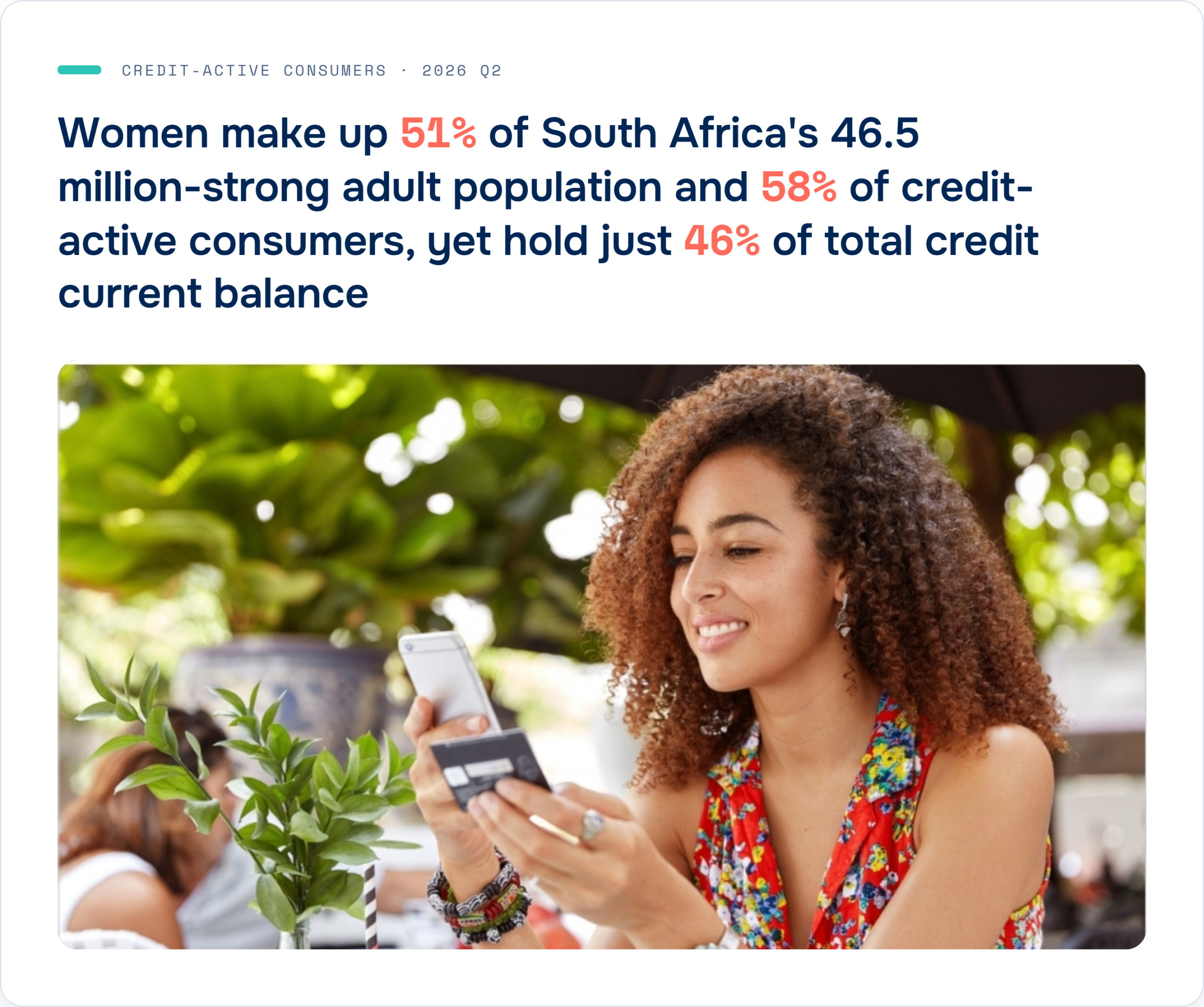
Women make up approximately 51% of South Africa’s 46.5 million-strong adult (15+) population in 2026, yet account for 58% of credit-active consumers in 2026 Q2, a modest overrepresentation relative to their population share. This headcount edge does not translate into equivalent exposure: women hold only 46% of total credit current balance versus 54% for men. The gap is most pronounced in vehicle asset finance, typically a high-value, secured product, where women hold just 41% of exposure.
Conversely, women are overrepresented in retail loans, holding 62% of exposure in this lower-value, unsecured product, echoing how less affluent segments lean on retail credit to supplement income. From a credit stress perspective, women have had more credit stress than men since at least mid-2023, though the gap has narrowed markedly over the past two quarters, pointing to a convergence in credit pressure between the genders.
The 2026 Q2 Credit Stress Report findings highlight a decline in optimism for the near-term economic outlook. While petrol prices dropped in July and August, it is set to rise again in September. Inflation has dropped from its peak in June, but is expected to remain above 4% for some time. Food inflation is a positive outlier, with year-on-year growth at its lowest levels in 16 years. The ongoing conflict in the Middle East remains the key risk for future outlook.
Download the Credit Stress Report